
Build. Personalize. Record. Play.
From playful interaction to real-life communication.


Mini-Talks creates playful and controllable ways for children with selective mutism to explore communication before carrying those experiences into everyday settings.
The system brings together three connected layers: physical experience through Mini-Kits, digital support through App & Studio, and social interaction through Mini-Community.
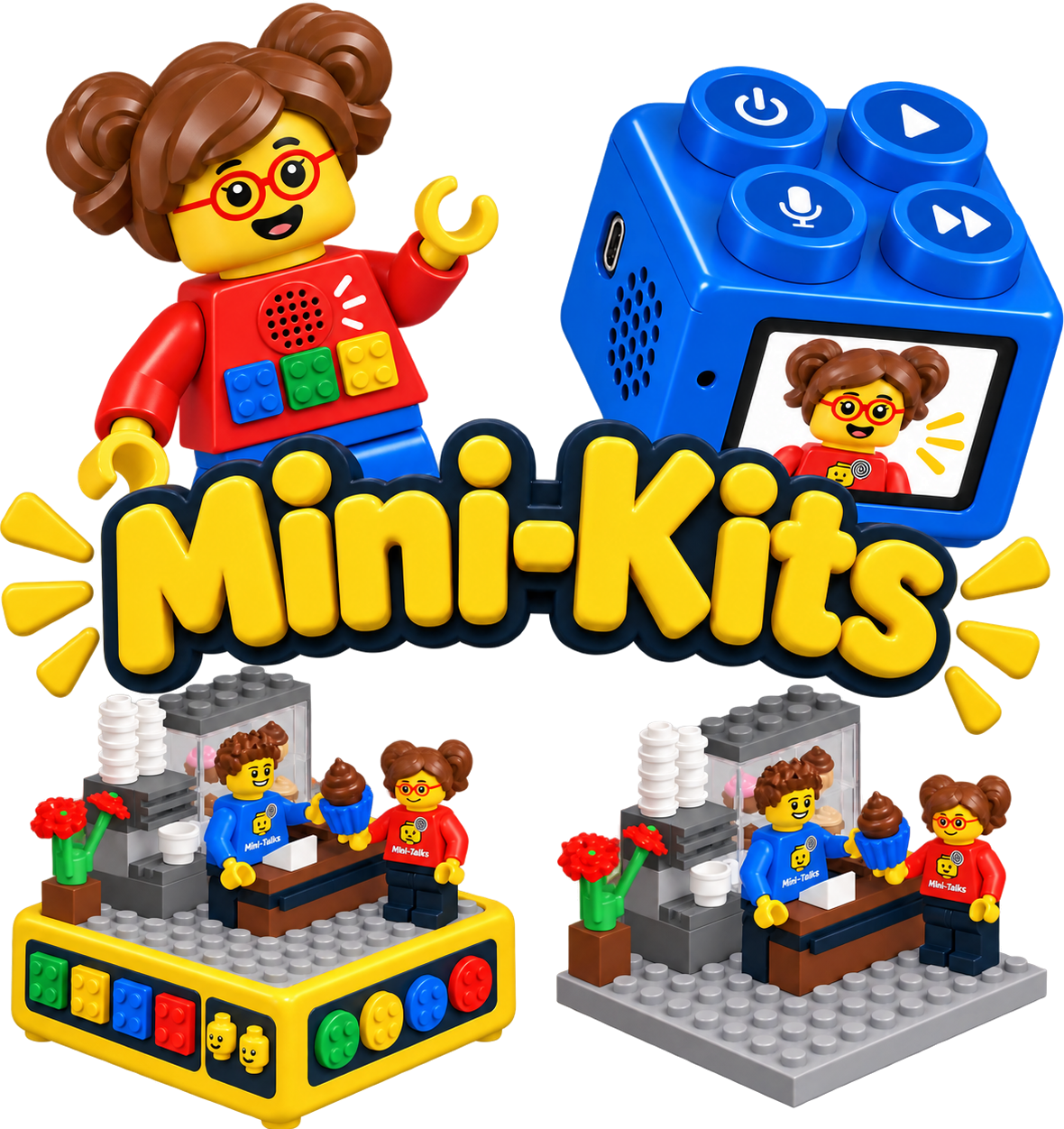
Within Mini-Kits, children can build social scenes, explore communication step by step, record and replay their voices, and connect those voices with personalized representations.
Together, these interactions make communication more tangible, familiar, repeatable, and personally meaningful.
Communication shifts from an abstract idea into something children can build, see, hear, and explore within physical scenes.
Children explore communication by building, touching, choosing, recording, and interacting rather than relying on verbal instruction alone.
Physical building, visual representation, recorded voice, and playback combine multiple forms of interaction within one communication experience.
Play-based communication experiences are designed to support gradual connection between practice within Mini-Kits and communication in everyday settings.
Mini-Kits consists of four core structures:
Mini-Designs, Design-Talks, Brick-Talks,
and
Fig-Talks.
Together, the four structures turn communication into something children can build, hear, see, and personalize.
Mini-Designs create the scene, Design-Talks structures communication within it, Brick-Talks brings recorded voice to life through animation, and Fig-Talks connects voice with a personalized physical figure.
Mini-Designs are unique sets designed using LEGO parts that allow children to build their own scenes.
These scenes represent real-life social environments, creating a space where communication can begin safely.
Discover Mini-Designs →Design-Talks is a recording and listening module that adds voice to scenes.
Children record their own voices, listen back, and bring their scenes to life with their own voices — all without being tied to a mobile screen.
Discover Design-Talks →Brick-Talks lets children choose personalized characters that appear on the screen and connect with their recorded voices.
As children record and replay their speech, the characters come to life through animation, making speaking more visual, familiar, and playful.
Discover Brick-Talks →Fig-Talks are personalized figures custom-made for each child.
These figures help children express themselves more comfortably and make communication more personal and something they can take ownership of.
Discover Fig-Talks →
Build the scene.
Play inside it.
Build communication through play.
Place the scene.
Explore communication step by step.
Give the scene a voice.
Record your voice.
Watch your character bring it to life.
Bring your voice to life.
Personalize your figure.
Record and replay your voice.
Speak through your own figure.
| Layer | Mini-Designs | Design-Talks | Brick-Talks | Fig-Talks |
|---|---|---|---|---|
| Role in System | Creates buildable social scenes where communication can begin. | Structures communication within each scene by level and mini. | Connects recorded speech with personalized on-screen characters and animation. | Connects recorded speech with a personalized physical figure. |
| Interaction Type | Physical play and scene building | Tangible + voice interaction | Voice + screen-based animated interaction | Voice + personalized physical interaction |
| User Action | Builds, explores, and role-plays. | Selects a level and mini, then listens, records, and replays. | Selects a personalized character, records, and replays their voice. | Records and replays their voice through the figure. |
| System Input | LEGO® parts, scene building, and imagination. | RFID scene, level, mini, action buttons, and voice recording. | Character slot selection, action buttons, and voice recording. | Record / Play controls and voice recording. |
| System Output | A physical scene for social play and interaction. | Scene-specific demos and recordings organized by communication level and mini. | Recorded voice playback with personalized character animation. | Recorded voice playback through the personalized figure. |
| Technology Level | None — fully physical | Embedded system — RFID + audio | Embedded system — display + audio | Embedded system — audio |
| Core Function | Provides a physical context for communication through play. | Provides structured, progressive, and repeatable communication practice. | Makes recorded speech visual, familiar, and playful through animation. | Makes voice expression personal and tangible through a figure designed to represent the child. |
| Dependency | Works independently and can connect with Design-Talks. | Designed to work with Mini-Designs; can also operate in default mode. | Works independently. | Works independently. |
| Core Insight | Communication can begin through building and shared play. | Communication can develop step by step through structure and repetition. | Recorded speech becomes more visual and playful when connected to a personalized character. | Voice becomes more personal when connected to a figure designed to represent the child. |
A tangible communication ecosystem grounded in embodied learning, multisensory engagement, structured communication, and personalized expression.
Social situations are transformed into buildable, playable scenes.
Play-based interaction
Social scenario simulation
Symbolic rehearsal
Safe exploration
Communication is scaffolded by scene, level, and role.
Tangible human-computer interaction
Communication scaffolding
Progressive communication levels
Pressure-free repetition
Recorded speech is connected to personalized characters through animation and playback.
Audio-visual feedback
Personalized character representation
Recorded voice playback
Playful reinforcement
A personalized physical figure connects identity with the child's recorded voice.
Identity-based interaction
Embodied expression
Personalized physical representation
Emotional ownership
Explore the social side of the project through Mini-Community and discover how playful communication experiences extend beyond the kits themselves.
 English
  Turkish
  German
  Danish